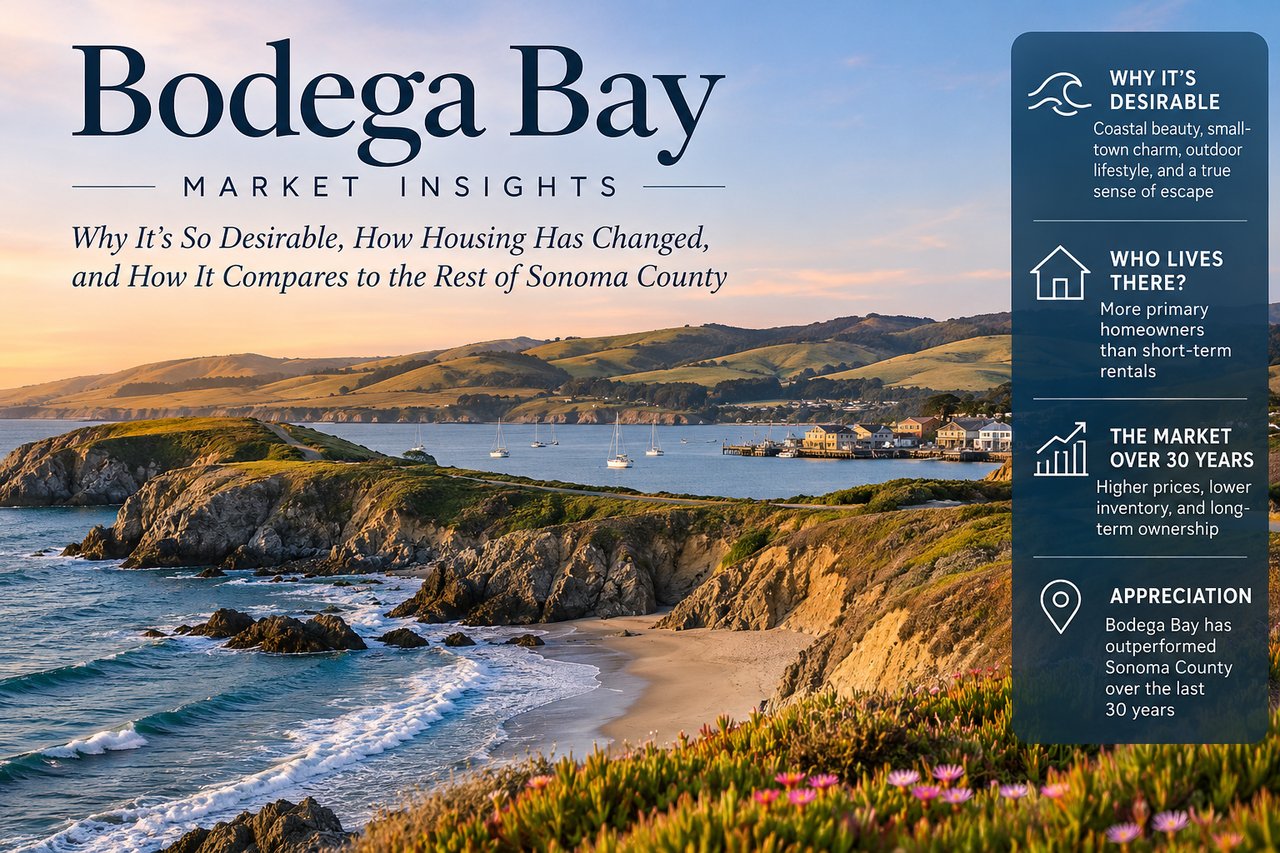
Why Is Bodega Bay So Desirable? 30 Years of Home Prices, Vacation Rentals, and Coastal Real Estate
buying home Nima Kazeroonian November 24, 2026
Who Really Owns Bodega Bay? An Inside Look at Property Values, Full-Time Residents, Second Homes, Housing Inventory, and Appreciation Since the 1990s
By Nima Kazeroonian | Broker Associate, Coldwell Banker Realty | CA DRE #01491305
Updated November 23, 2026
There's something about Bodega Bay that makes people want to stay.
Maybe it's the sound of the Pacific Ocean, the dramatic coastal bluffs, the fishing boats coming into the harbor, or the feeling of being somewhere completely different from the rest of the Bay Area—even though you're still in Sonoma County.
For some, Bodega Bay is a weekend escape.
For others, it's a place to retire, raise a family, or enjoy the quieter pace of coastal living.
And for a growing number of people researching the area, it's a real estate market that raises some interesting questions.
Why are Bodega Bay homes so expensive? Are most houses occupied by full-time residents or vacationers? How much have values appreciated over the past 30 years? And why do so few properties seem to come up for sale?
The answers reveal a housing market unlike most of Sonoma County.
Bodega Bay has long been a community of permanent residents, second homes, and seasonal visitors. Limited turnover, exceptional natural surroundings, and a relatively small housing stock have all helped shape its real estate market.
But the numbers also reveal something surprising: Bodega Bay was a second-home destination long before Airbnb became popular.
Let's explore how this remarkable coastal community has evolved since the 1990s, what the latest housing data shows, and what it means for anyone considering buying or selling a home here.
Bodega Bay offers something increasingly difficult to find in Northern California: a combination of coastal scenery, relative seclusion, and access to the greater Bay Area.
Drive west from Santa Rosa or Sebastopol and the landscape changes dramatically.
Vineyards and rural hills eventually give way to coastal grasslands, windswept trees, sandy beaches, and the Pacific Ocean.
Unlike more densely developed coastal destinations, Bodega Bay retains much of its small-community character.
According to Sonoma County Tourism, visitors and residents can enjoy whale watching, kayaking, hiking, fishing, birdwatching, beaches, and coastal golf.
Bodega Head is particularly well known for its sweeping ocean views and opportunities to observe migrating whales.
Doran Regional Park offers a long, sandy beach along the protected waters of Bodega Harbor.
And the surrounding coastline includes dramatic cliffs, secluded coves, and scenic stretches of Highway 1.
But the appeal goes beyond recreation.
Bodega Bay offers a pace of life that contrasts with busier communities farther inland.
For someone who spends much of the week navigating traffic, working in an office, or living in a more densely populated environment, a home overlooking the Pacific can represent a significant lifestyle change.
Ocean views, natural surroundings, and opportunities for outdoor recreation can be important motivations for buyers.
Bodega Bay's geography creates natural limits.
The Pacific Ocean, harbor, steep coastal terrain, and surrounding open spaces affect where housing can be located.
Development is also subject to applicable coastal planning, environmental review, zoning, infrastructure requirements, and other restrictions.
This does not mean new development is impossible.
It means the community cannot expand outward like a large inland suburb.
For long-term homeowners, limited opportunities for substantial expansion are an important part of understanding the local housing market.
The same property might attract very different prospective buyers.
A retired couple may want a peaceful primary residence.
A Bay Area professional might be searching for a weekend retreat.
A family may be interested in creating a multigenerational vacation home.
Another buyer may be evaluating an eligible property for potential vacation-rental use.
Each group approaches property ownership differently.
That diversity of demand is one reason Bodega Bay deserves to be analyzed separately from the broader Sonoma County housing market.
This is perhaps the most fascinating question about the community.
And the answer requires an important distinction.
A second home is not necessarily a short-term rental.
Some properties are used exclusively by their owners on weekends and holidays.
Others may be rented occasionally.
Some are operated as vacation rentals.
And many properties serve as year-round residences.
The U.S. Census Bureau and vacation-rental data companies measure these categories differently.
According to the 2020–2024 American Community Survey estimates, Bodega Bay had approximately 950 housing units.
Here's how those units were classified:
Housing classification | Estimated units |
|---|---|
Owner-occupied primary residences | 360 |
Renter-occupied primary residences | 131 |
Vacant housing units, including seasonal use | 459 |
Total housing units | 950 |
Source: U.S. Census Bureau, 2020–2024 American Community Survey five-year estimates, via Census Reporter and Point2Homes. Small-community estimates have substantial margins of error.
That means approximately 48.3% of Bodega Bay's housing units were classified as vacant under the census definition.
Now, that doesn't mean almost half the properties were abandoned.
Census vacancy includes homes without usual year-round occupants, including properties used seasonally or occasionally.
A beautifully maintained oceanfront home used by its owners for several months each year may be considered vacant for census purposes.
Of the homes that were occupied as primary residences, approximately 73.3% were owner-occupied and 26.7% were renter-occupied.
That's an important distinction.
Most year-round occupied homes are owner-occupied, but year-round owner-occupied homes represent only about 38% of the total estimated housing stock.
So Bodega Bay is neither exclusively a vacation-rental town nor a conventional year-round residential community.
It's a mixture of both worlds.
According to AirDNA's Bodega Bay market report, updated November 17, 2026, approximately 374 short-term rental listings were active in the Bodega Bay market as of October 2026.
For perspective, that's numerically close to the Census Bureau's estimate of 360 owner-occupied primary residences.
However, the figures are not directly interchangeable.
AirDNA counts tracked rental listings within its market boundaries, while the census counts residential housing units and households within the Bodega Bay census-designated place.
A listing count does not necessarily equal the number of unique, permitted residential properties. Geographic coverage, duplicated platform listings, and reporting dates can also differ.
Therefore, it would be inaccurate to conclude that Bodega Bay definitively has more vacation-rental properties than full-time homeowner households.
What we can confidently say is that vacation and seasonal housing represent a very substantial part of Bodega Bay's residential market.
And that has been true for decades.
It's easy to assume that the popularity of short-term rental platforms fundamentally transformed Bodega Bay from a full-time residential town into a vacation destination.
But the historical census data tells a different story.
A 2007 report from the National Oceanic and Atmospheric Administration, using the 2000 U.S. Census, found that Bodega Bay had 1,144 housing units at the beginning of the century.
Approximately 41.5% were classified as vacant.
And approximately 88.4% of those vacant units were used seasonally.
In other words, around the year 2000, more than one-third of Bodega Bay's entire housing stock was associated with seasonal use.
This was years before Airbnb became a major component of the vacation lodging industry.
The NOAA community profile provides valuable historical context.
By 2020, the decennial census counted 1,009 housing units in Bodega Bay, including 549 classified as vacant.
That's approximately 54.4% of the housing stock.
Housing characteristic | 2000 census | 2020 census |
|---|---|---|
Total housing units | 1,144 | 1,009 |
Vacant housing units | Approximately 475 | 549 |
Vacant share | 41.5% | 54.4% |
Sources: NOAA's analysis of the 2000 census and California Department of Finance's 2020 Census Redistricting Profile.
These figures show that non-primary-residence housing has played a large role in the community for many years.
The change in housing-unit counts should not automatically be interpreted as homes being demolished. Differences in census boundaries, classification, and housing-unit reporting may affect historical comparisons.
The more important conclusion is that Bodega Bay's seasonal character predates modern vacation-rental platforms.
Airbnb and other rental services have changed how some properties are marketed and occupied, but they didn't create the underlying demand for coastal second homes.
Now let's examine the real estate numbers.
For a historical comparison, I reviewed the BAREIS MLS 1999–2025 Sonoma County Year-End Statistics.
This public dataset provides a consistent historical series for Coastal Sonoma and Sonoma County as a whole.
One distinction is important: BAREIS's Coastal Sonoma market area includes properties beyond Bodega Bay. Therefore, those historical figures are useful regional benchmarks, not exact Bodega Bay-only appreciation statistics.
The public series begins in 1999, so the comparison covers 26 years rather than a complete 1996–2026 period.
Year | Coastal Sonoma median sale price | Sonoma County median sale price |
|---|---|---|
1999 | $374,000 | $237,000 |
2000 | $461,100 | $283,000 |
2005 | $912,500 | $550,000 |
2010 | $600,000 | $330,800 |
2015 | $752,020 | $500,500 |
2020 | $1,000,000 | $675,000 |
2025 | $1,320,000 | $799,000 |
Source: BAREIS MLS, residential closed-sale median prices. These are annual market medians and reflect the homes sold in each year, not the appreciation of an identical group of properties.
Look closely at the difference between 1999 and 2025.
Coastal Sonoma's median sale price increased from $374,000 to $1.32 million.
That's an increase of approximately 253%.
Across Sonoma County, the median increased from $237,000 to $799,000.
That's approximately 237%.
Over the period covered by these statistics, the broader coastal market slightly outpaced the countywide median-price increase.
But perhaps the most interesting part isn't the percentage.
It's the consistency of the coastal price premium.
In 1999, the coastal median was already significantly higher than the countywide median.
By 2025, that difference remained substantial.
The market has experienced recessions, changes in mortgage rates, periods of rapid appreciation, and slower sales cycles.
Yet coastal properties have continued to command higher median prices than the county overall.
Notice that the coastal median was approximately $912,500 in 2005 but $600,000 in 2010.
That's an important reminder that coastal real estate is not immune to broader market downturns.
Bodega Bay and the surrounding coast are desirable, but desirability does not guarantee uninterrupted appreciation.
Buyers should never assume that ocean views eliminate market risk.
Long-term values depend on economic conditions, financing, property characteristics, and buyer demand.
Annual median sale prices reflect the particular properties sold.
If one year includes more luxury oceanfront estates and another includes more modest inland cottages, the median can change even when individual property values follow a different pattern.
A true same-property appreciation study would require matched sales or a quality-adjusted repeat-sales index.
That distinction matters particularly in a small coastal market where only a limited number of properties sell each year.
Nevertheless, the BAREIS data provides strong evidence of the coastal market's long-term price premium and substantial growth in nominal sale prices.
For a more specific look at Bodega Bay, let's examine recent local figures.
According to the 2025 annual market report published by Vanguard Properties, Bodega Bay recorded:
Indicator | 2025 result |
|---|---|
Single-family homes sold | 43 |
Median sale price | $1,405,000 |
Median days on market | 34 |
Prior-year median sale price | $1,350,000 |
The median sale price increased approximately 4.1% from 2024 to 2025.
Across Sonoma County, the same report showed a 2025 single-family median sale price of approximately $836,000.
That placed Bodega Bay's median roughly 68% above the countywide single-family median.
Of course, this doesn't mean every Bodega Bay property is worth $1.4 million.
Actual prices can vary considerably.
A smaller home without ocean views may occupy a very different price range from a custom bluff-top property overlooking the Pacific.
As of September 2026, Zillow's Bodega Bay housing data estimated a typical home value of approximately $1.45 million, compared with approximately $783,000 for Sonoma County.
That is a modeled typical-home-value measure, not a closed-sale median, but it provides another indication of the substantial coastal price premium.
Not necessarily.
A panoramic ocean view can influence demand and value, but other characteristics matter.
These may include the condition of the home, proximity to coastal hazards, insurance availability, maintenance expenses, accessibility, lot characteristics, and local development restrictions.
Two properties located relatively close to one another may have different long-term appreciation patterns.
A comprehensive property-specific market analysis is far more useful than applying a single coastal appreciation percentage to every home.
One of the most distinctive aspects of Bodega Bay is the relatively limited number of homes.
Historical census records illustrate the scale of the community.
Census year | Bodega Bay housing units |
|---|---|
1990 | 831 |
2000 | 1,144 |
2010 | 1,060 |
2020 | 1,009 |
Sources: U.S. Census Bureau decennial housing counts, published in the California 2010 Census report and 2020 Census data.
The 1990 and 2020 counts differ by 178 units, an increase of approximately 21%.
That is a relatively modest net change over three decades compared with what buyers might associate with rapidly expanding suburban communities.
The intermediate decline after 2000 also deserves caution because census geography and counting practices can change.
These totals should not be treated as a direct measurement of how many homes were constructed, removed, or converted during each decade.
Still, the figures show that Bodega Bay remains a small housing market.
According to Zillow, Bodega Bay had approximately 24 properties listed for sale as of September 30, 2026.
That number changes as properties are listed, sold, withdrawn, or placed under contract.
It also depends on the geographic boundaries and property types included by the listing service.
But it illustrates an important point.
Even when several dozen properties are available, the number meeting an individual buyer's criteria may be much smaller.
A buyer searching specifically for a single-story ocean-view home with a particular floor plan and budget may have very limited choices.
The BAREIS historical dataset recorded 95 residential sales throughout its broader Coastal Sonoma area in 1999.
In 2025, that figure was 45.
Sonoma County as a whole recorded 7,103 residential sales in 1999, compared with 4,095 in 2025.
Both markets experienced fewer transactions in 2025 than in 1999, although individual years varied considerably.
These annual sales figures are not the same as active listing inventory.
Nevertheless, they demonstrate that the coastal market handles a comparatively small number of transactions.
In a market with relatively few sales, buyers and sellers need to interpret individual comparable properties carefully.
This is an excellent question, and one that deserves a careful answer.
There is no publicly verified Bodega Bay-specific median ownership duration in the sources I reviewed that would justify claiming local owners keep their properties for a precise number of years.
However, we can examine some useful context.
According to Redfin's 2026 homeowner tenure research, the typical U.S. homeowner had remained in their home for approximately 12 years as of 2025.
In the San Francisco metropolitan area, median homeowner tenure was approximately 16.5 years.
Those are not Bodega Bay statistics.
They simply show that long ownership periods are common in many California markets.
Bodega Bay also has special characteristics that may encourage some owners to hold properties for extended periods.
A vacation home might remain in a family as a gathering place for multiple generations.
A retired owner may choose to stay because of the coastal lifestyle.
A second-home owner may not feel compelled to sell when market conditions soften.
And owners with longstanding property-tax assessments or favorable financing may have financial reasons to retain their properties.
At the same time, there are owners who sell after only a few years.
The best way to measure actual Bodega Bay ownership duration would be to analyze recorded purchase and resale dates for individual properties across the community.
That would allow calculation of the median holding period for homes that have changed ownership, while distinguishing full-time residences, inherited properties, and other transfers where possible.
Annual sales counts alone cannot establish how many years a typical owner has held a home.
For buyers, the practical takeaway is to recognize that desired properties may not come onto the market frequently.
For owners, it reinforces the importance of evaluating the current market carefully before deciding to sell.
Bodega Bay continues to have a substantial visitor accommodation market.
AirDNA's October 2026 data reported approximately 374 active short-term rental listings, with average annual listing revenue of approximately $82,200 over the preceding 12 months.
The report also showed an average daily rate of approximately $479 and occupancy of about 55% of available nights.
Those are market-level estimates, not guaranteed earnings for an individual home.
Importantly, the revenue figure is gross rental revenue.
It does not establish profitability after mortgage expenses, property taxes, insurance, cleaning, maintenance, utilities, management fees, regulatory expenses, or periods when the owner personally uses the home.
A property's performance may differ substantially depending on its size, location, amenities, condition, and booking strategy.
No. Buyers should not assume that every property is eligible.
Bodega Bay is in unincorporated Sonoma County, and vacation rentals in the Coastal Zone are subject to applicable county requirements.
According to Permit Sonoma's coastal vacation-rental guidance, newly operating vacation rentals generally require appropriate property-manager certification, zoning approval, transient occupancy tax registration, and a vacation-rental license.
Existing operations may be subject to different provisions depending on when they began and their permit history.
Before purchasing a property for short-term rental use, buyers should verify the parcel's eligibility, applicable permits, current ordinances, HOA restrictions, and whether any existing authorization can continue following a change of ownership.
A home's previous use as a vacation rental does not automatically guarantee that a new owner can operate it in the same manner.
For buyers considering an investment, I recommend evaluating the home first as a real estate asset and then separately investigating its legal rental potential and realistic financial performance.
When comparing Bodega Bay with Santa Rosa, Petaluma, Windsor, Rohnert Park, or other Sonoma County communities, several distinctions become clear.
Most inland cities have larger housing stocks and more diverse neighborhoods.
Bodega Bay's residential market is much smaller, and a significant share of housing is used seasonally.
Inland buyers are often focused on full-time housing needs, including employment access, household size, and community amenities.
Bodega Bay buyers may place additional emphasis on coastal scenery, privacy, second-home use, or retirement plans.
There is substantial overlap, but the motivations can differ.
Coastal homes may require additional consideration of weather exposure, salt-air maintenance, drainage, insurance, and location-specific environmental conditions.
A home closer to the waterfront may also require careful evaluation of coastal erosion, flooding, or other hazards, depending on its location.
Those issues should be assessed individually rather than assumed to affect every property equally.
Bodega Bay's market consistently shows a substantial premium over Sonoma County's overall median.
But comparing an ocean-view coastal home with a conventional inland subdivision property solely by square footage can be misleading.
The location and lifestyle are part of what buyers are purchasing.
The coastal market records relatively few annual transactions, and many homes are used as second residences.
That can create a more specialized buying and selling environment.
Together, these factors help explain why broad Sonoma County market averages may not accurately represent the value of an individual Bodega Bay property.
For the right buyer, Bodega Bay offers something distinctive.
A primary residence can provide access to a coastal lifestyle that differs substantially from inland living.
A second home may offer a place for weekends, vacations, and family gatherings.
And an eligible rental property may have investment potential, provided the economics and regulations make sense.
But there are important considerations.
Buyers should carefully evaluate insurance costs, maintenance requirements, coastal exposure, access, financing, and any rental restrictions.
They should also be comfortable with the limited availability of directly comparable homes.
Bodega Bay's historical price premium doesn't guarantee future appreciation.
And a property purchased primarily for rental income should be evaluated against realistic expenses and occupancy assumptions.
My perspective is that Bodega Bay deserves serious consideration from buyers who value the lifestyle and understand the costs of ownership.
The goal should be purchasing a property that fits both your needs and your financial circumstances.
For current opportunities, you can explore homes for sale throughout Sonoma County or visit my Bodega Bay neighborhood guide.
Bodega Bay sellers face a somewhat different challenge than many homeowners farther inland.
Your property may attract buyers from outside the immediate area who are less familiar with the local market.
They may be comparing several coastal communities rather than looking exclusively in Bodega Bay.
And because the number of comparable closed sales can be limited, establishing an appropriate asking price may require particularly careful analysis.
I would focus on several factors before bringing a Bodega Bay property to market.
View and location: What distinguishes the property from competing listings? Is the ocean visible from principal living areas, outdoor spaces, or bedrooms?
Condition and maintenance: How well has the home been maintained, particularly in relation to coastal weather exposure?
Property documentation: Are relevant permits, repair records, and disclosure information readily available?
Insurance and ownership expenses: Can buyers obtain appropriate insurance, and what additional costs should they anticipate?
Rental history, when applicable: If the property has legitimately operated as a vacation rental, accurate documentation may be relevant to certain buyers, but no particular income level should be promised.
Pricing: What have truly comparable properties sold for, and how does the current listing competition affect your position?
A well-prepared home can appeal to a wide range of prospective buyers.
However, even a desirable Bodega Bay property can remain on the market if its asking price is not supported by current conditions.
If you're curious what your Bodega Bay home could sell for, I can prepare a comparative market analysis that considers the characteristics of your property and recent coastal sales.
Start with a free home valuation, or contact me directly for a more detailed discussion.
Bodega Bay combines desirable coastal surroundings, a relatively small housing market, ocean-view properties, and demand from both full-time and second-home buyers. These factors contribute to its substantial price premium over Sonoma County as a whole.
The 2020 census classified approximately 54.4% of housing units as vacant, a category that includes seasonal and occasional-use homes. This suggests that non-primary-residence housing represents a particularly large share of the community. However, it does not mean all those homes are short-term rentals.
AirDNA tracked approximately 374 active short-term rental listings in its Bodega Bay market as of October 2026. That figure should not be interpreted as an exact count of distinct, legally permitted residential properties.
A consistent public Bodega Bay-only appreciation series covering 1996 through 2026 was not verified. However, BAREIS records show the broader Coastal Sonoma area's median residential sale price increased approximately 253% from 1999 to 2025, compared with approximately 237% for Sonoma County overall. Those are changes in annual sale-price medians, not same-property appreciation rates.
In 2025, Bodega Bay recorded 43 single-family home sales in the annual market report reviewed for this article. Annual totals vary depending on economic conditions, listing activity, and the particular property types included.
A verified Bodega Bay-specific median ownership period was not available from the public sources reviewed. National and regional homeowner-tenure studies provide context, but calculating a local figure requires an analysis of recorded ownership transfers.
Bodega Bay has an older population than many communities. The 2020–2024 American Community Survey estimated a median age of approximately 52.4 years. However, that does not mean all residents are retired, and the population includes different household types and ages.
That depends on the individual property's purchase price, legal rental eligibility, financing, operating expenses, realistic revenue, and the buyer's financial goals. Market-level rental figures should never replace property-specific due diligence.
After examining decades of housing data, one thing becomes clear.
Bodega Bay's appeal is not new.
Long before vacation-rental platforms became popular, the community had a substantial number of seasonal homes.
Long before today's housing prices reached seven figures, coastal properties already commanded a significant premium over much of Sonoma County.
And despite changing economic conditions, Bodega Bay continues to attract people who value its distinctive environment.
But there is no single type of Bodega Bay homeowner.
Some have lived there for decades.
Others visit when their schedules allow.
Some have inherited family properties.
Others are purchasing their first coastal home.
And some are evaluating properties as potential investments.
That diversity is part of the community's character.
Whether you're a permanent resident, a second-home owner, or someone considering a purchase, the most useful information is not simply what homes sold for last month.
It's understanding how this small coastal market works, how individual properties compare, and what your options may look like over time.
I'm Nima Kazeroonian, Broker Associate with Coldwell Banker Realty.
I've called the Bay Area home for more than four decades and have been helping people navigate real estate transactions since 2005.
Whether you're considering buying a coastal retreat, selling a longtime family property, relocating, downsizing, or simply researching your home's value, I'm happy to help you understand the market.
If you own a Bodega Bay home: I can review comparable properties, current listings, and local conditions to help you understand its estimated market value.
If you're considering purchasing: I can help you evaluate available homes, pricing, property characteristics, and the due-diligence questions that matter in a coastal transaction.
You don't need to be ready to make a move.
Sometimes the first step is simply getting better information.
Find Out What Your Bodega Bay Home Could Be Worth
Explore Bodega Bay and Sonoma County Homes for Sale
Learn More About Living in Bodega Bay
Contact Me for a Personalized Real Estate Consultation
Nima Kazeroonian
Broker Associate | REALTOR®
Coldwell Banker Realty
CA DRE #01491305
Call or Text: 707-486-9055
Website: www.nima.homes
Data reflects the cited sources available as of November 23, 2026. Census-designated place boundaries, MLS market areas, ZIP codes, and rental-platform reporting areas do not necessarily match. Historical housing figures, median sale prices, modeled property values, and rental listing counts represent different measures. Small-market statistics can fluctuate considerably and should not be treated as guarantees of future property values or rental performance.
buying home
Who Really Owns Bodega Bay? An Inside Look at Property Values, Full-Time Residents, Second Homes, Housing Inventory, and Appreciation Since the 1990s

buying home
The Truth About Home Prices, Price Reductions, Seller Credits, Mortgage Rates, and Negotiating a Better Real Estate Deal

Fewer Competing Listings, Motivated Buyers, and a Holiday Housing Market That Could Create Opportunities Before 2027

What Santa Rosa, Windsor, Petaluma, Sebastopol, and Sonoma County Homeowners Should Know About Wildfire Risk, Insurance Costs, and Selling a Home

buying home
Home Prices, Mortgage Rates, and What Buyers and Sellers Should Know in Santa Rosa, Windsor, Petaluma, Rohnert Park, and Across Sonoma County
Two 2026 sales, three costs to compare, and what nearby new construction means for WillowGlen homeowners.
buying home
A November 5, 2026, zoning change brings fresh questions about backyard cottages, rental income, and resale value. Here’s what buyers, sellers, and homeowners should k… Read more
Compare Petaluma, Rohnert Park, Cotati, Santa Rosa, and Windsor for a move that works on office days and at home—with SMART, ferry connections, and practical homebuyin… Read more
buying home
Can your next move fit your budget? Compare current Santa Rosa housing data, sample ownership costs, and the expenses buyers and sellers should review.
Whether you're buying, selling, or exploring options, Nima is dedicated to making the process smooth, informed, and rewarding. Reach out today for a personalized consultation and let’s make your real estate goals a reality!