Santa Rosa Homeownership vs Renting: 30‑Year Trends for 2026
Nima Kazeroonian December 9, 2025
Nima Kazeroonian December 9, 2025
Santa Rosa, the largest city in Sonoma County, has long been a desirable place to live. Yet the balance between owning and renting has evolved dramatically over the past few decades. In this post, we examine how the homeowner‑to‑renter ratio has shifted over the last 10, 20 and 30 years, why more residents are renting longer, and whether rental housing stock is dominated by single‑family homes or apartments.
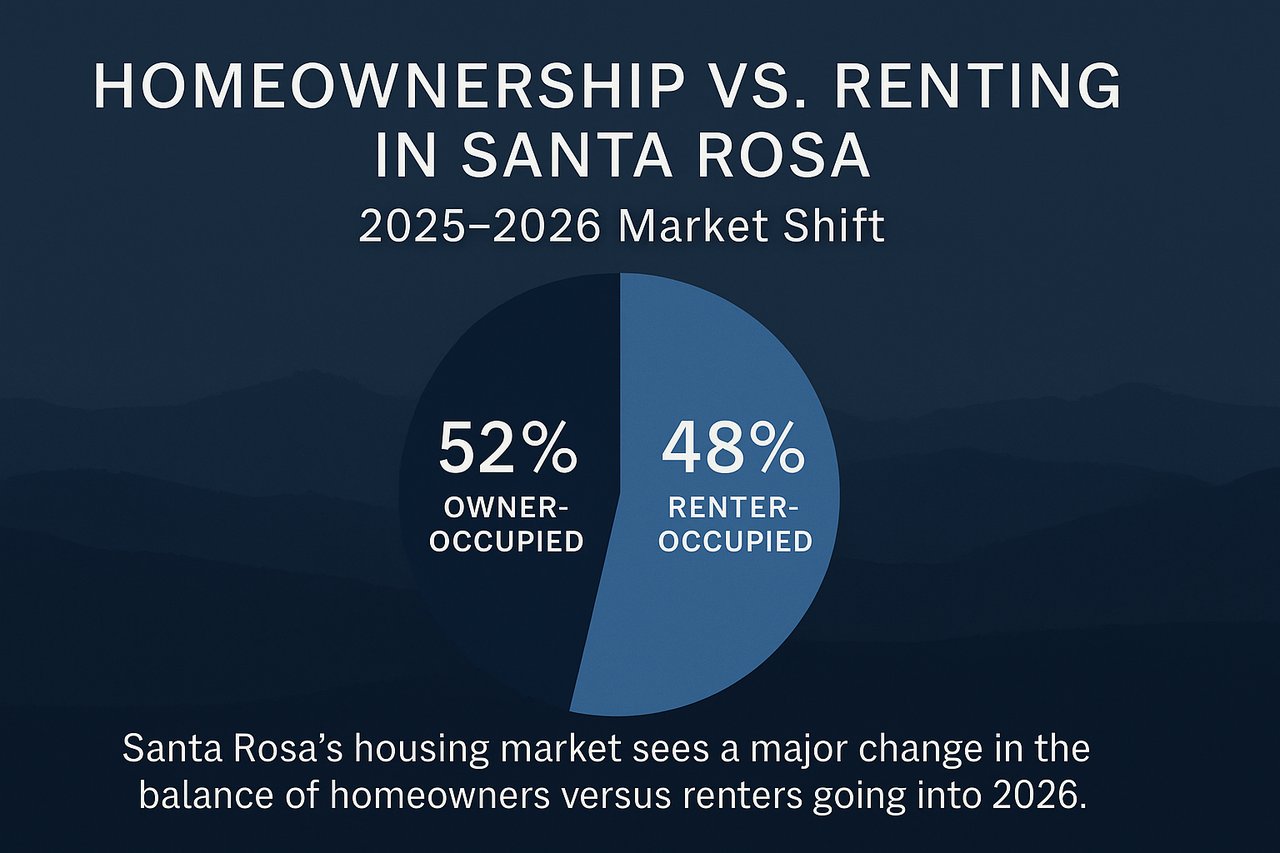
According to DataUSA’s 2023 figures, about 56.2 % of Santa Rosa’s housing units are owner‑occupied datausa.io. This is lower than the national average (around 65 %) and a slight uptick from the previous year’s 55.7 % datausa.io. The median property value was $685 k in 2023 datausa.io, underscoring the affordability challenges that encourage many residents to continue renting.
A decade ago, Santa Rosa’s homeownership rate hovered in the mid‑ to upper‑50s. A 2017 HUD report estimated the homeownership rate at 58.1 %, down from 60.4 % in 2010steadily.com. The decline accelerated after the 2017 Tubbs Fire, which constrained supply, and the pandemic era’s surging home prices. Despite a slight uptick in 2023, the overall trend over the last 10 years is a gradual decrease in homeownership, driven by rising costs, insurance premiums and limited inventory.
Two decades ago, homeownership rates across Sonoma County and Santa Rosa were higher—often in the low‑60 % range. The 2007–2009 financial crisis led to foreclosures and tighter lending standards, pushing many would‑be buyers into long‑term rentals. Subsequent recovery brought home prices back up, but incomes didn’t keep pace, widening the affordability gap. By 2015 the homeownership rate had slipped into the high‑50s, where it remains today.
In the mid‑1990s, Santa Rosa’s homeownership rate was likely closer to the national average (around 64–65 %). Over 30 years, several factors—housing booms and busts, demographic shifts, and cost‑of‑living increases—have gradually eroded ownership rates. The city’s robust job market attracts newcomers, many of whom choose to rent for flexibility. The long‑term trend shows a steady rise in renting, especially among younger households and retirees downsizing to smaller, maintenance‑free homes.
The tight housing market has turned many renters into long‑term tenants. High down payments, elevated mortgage rates and growing insurance costs mean it takes longer to save for a home. According to Generation Housing’s Sonoma County report, cities like Santa Rosa and Sebastopol have higher rentership rates than smaller towns, with nearby Rohnert Park’s rentership nearing 50 % generationhousing.org. This indicates a broad regional shift toward longer rental tenures.
Short‑term rentals (vacation homes and Airbnbs) do exist—particularly for Wine Country tourism—but Santa Rosa has regulated non‑hosted short‑term rentals to preserve housing for locals. As a result, most rental stock serves long‑term residents rather than transient visitors.
Historically, Santa Rosa’s rental market was dominated by single‑family homes. However, two trends are changing the landscape:
Build‑to‑Rent Single‑Family Homes: While the South leads the build‑to‑rent boom, California added more than 1,800 build‑to‑rent homes in 2024blog.bayareametro.gov. This suggests more detached rental homes may enter the market in coming years.
Rise of Apartments: Santa Rosa is seeing a surge in multifamily development. New luxury complexes like the eight‑story Felix building downtown offer upscale amenities and signal a shift toward urban density. Generation Housing notes that rentership is particularly high in cities with more apartmentsgenerationhousing.org. Zillow’s rental listings also show hundreds of available apartments across the cityfred.stlouisfed.org, implying that apartments now represent a significant share of rental inventory.
Prospective Buyers: Expect continued competition for a limited number of homes, especially in desirable neighborhoods like Rincon Valley, Bennett Valley and Fountaingrove. Mortgage rates may ease slightly, but insurance and construction costs could keep prices elevated.
Long‑Term Renters: Renting may remain the norm for many residents, particularly younger households and households affected by rising insurance premiums. However, new apartment supply should offer more options.
Investors and Landlords: Build‑to‑rent single‑family homes and luxury apartments could provide strong rental demand. Investors should monitor local regulations around short‑term rentals and ensure properties serve long‑term housing needs.
Over the last 30 years, Santa Rosa has shifted from a predominantly homeowner city to a balanced community where owners and renters each make up roughly half the households. Affordability challenges, demographic trends and new rental supply have kept many residents in rentals longer. As we move into 2026, Santa Rosa’s housing market remains dynamic, offering opportunities for savvy buyers, renters and investors alike.
Along with this checklist, seeking guidance from a professional is always a good idea!

Gov't Shutdown

Less competition, motivated participants, and market insights for the season

When to hire Nima, secure pre-approval, and navigate the North Bay market

Exploring the pros and cons of homeownership versus renting across different time horizons
Whether you're buying, selling, or exploring options, Nima is dedicated to making the process smooth, informed, and rewarding. Reach out today for a personalized consultation and let’s make your real estate goals a reality!