
Should I Sell in Sonoma County Now? December 2025 Market Insights for Home Sellers
Nima Kazeroonian December 15, 2025
Nima Kazeroonian December 15, 2025
As the year winds down and holiday lights twinkle across Santa Rosa, Healdsburg and the rolling vineyards of Sonoma County, many homeowners find themselves asking a pivotal question: should I sell now or wait? Real estate decisions are deeply personal, but they are also influenced by larger market forces. Understanding those forces can turn uncertainty into confidence. The Sonoma County market has been through intense ups and downs in recent years, from pandemic-era bidding wars to cautious buyers watching interest rates. December 2025 finds us at an inflection point. Inventory is beginning to open up, mortgage rates are stabilizing, and buyers are looking for opportunities. This blog explores whether selling right now makes sense, drawing on the latest data, forecasts and the unique nuances of our local neighborhoods. We’ll look at pricing trends, supply and demand, segment differences, 2026 projections and, most importantly, how your own goals align with the market landscape.
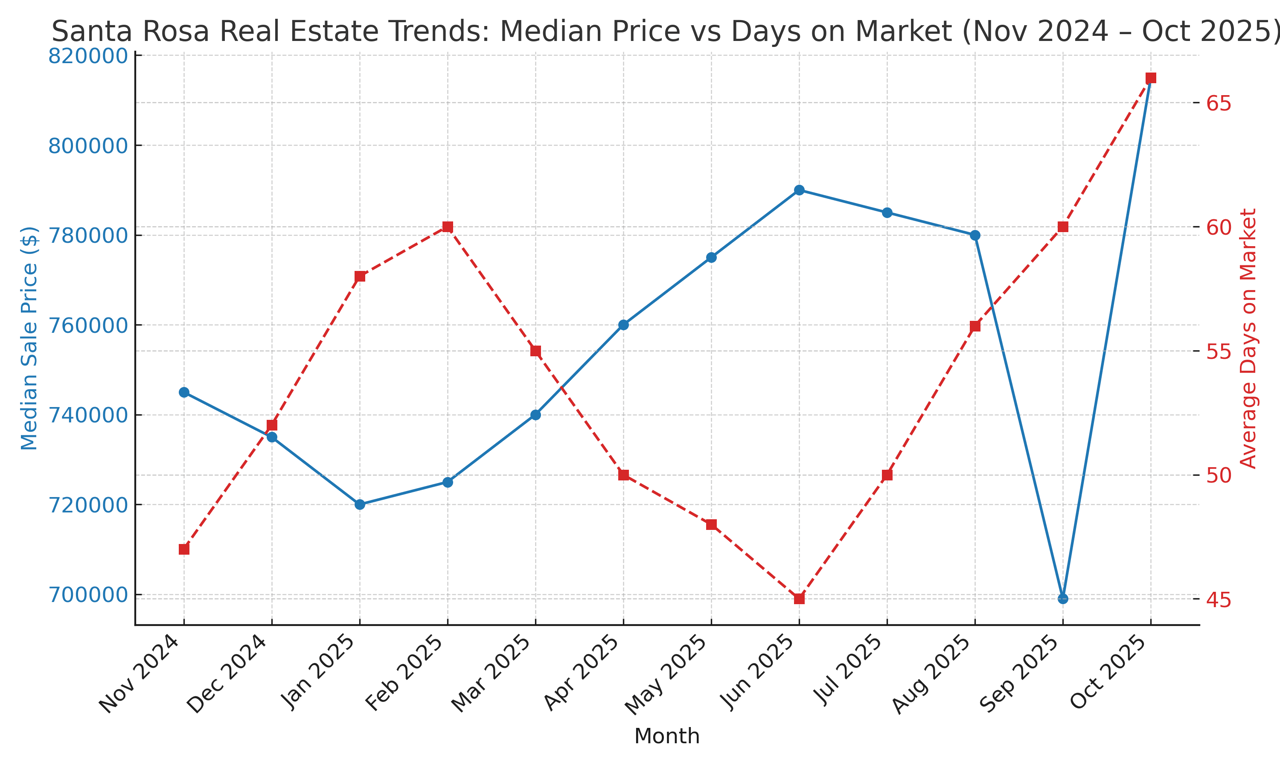
Before deciding if now is the right time to list, it’s important to understand where the market stands today. According to Redfin’s October 2025 report, the median sale price in Sonoma County was about $783,000, down 0.63 % compared with the previous year, with homes taking an average of 49 days to sell versus 38 days last year (4.0 quake centered in Sonoma County triggers alert, followed by aftershocks). While that slight decrease in price might seem discouraging, it’s far from a crash. Instead, it suggests the market is normalizing after frenzied pandemic highs. The days-on-market metric indicates that buyers are taking more time to make decisions, giving sellers a wider window for negotiations. Another set of numbers from Santa Rosa Fine Homes’ Fall 2025 report shows a median listing price around $998,000 (up 5 % year over year) and a median sales price around $820,000 (down 7 %), with 1,368 active listings (10 % more than last year) and homes spending about 60 days on market (Sonoma County’s Housing Market Just Shifted (Here’s Why)). These figures paint a picture of a balanced market with moderate price adjustments and steady buyer demand. Inventory is modestly higher than a year ago, meaning sellers have competition, but buyer interest remains solid.
The modest drop in sales price and increase in listings are being driven by multiple factors. High mortgage rates in early 2025 kept many buyers sidelined, but as rates drift downward into the 6 % range, more qualified buyers are coming back. Meanwhile, a backlog of would-be sellers who held off during the uncertainty of 2023–2024 are now preparing to list, adding supply. At the same time, the county’s enduring appeal—its vineyards, coastal proximity, and small-town charm—continues to draw newcomers from the Bay Area and beyond. This push-and-pull dynamic has cooled the rapid price growth of recent years without tipping the market into a slump. It’s in this balanced environment that sellers need to craft a thoughtful strategy.
One of the most important aspects of the Sonoma County market is its segmentation. Not all homes perform the same. A 2025 analysis by Modern Living Sonoma highlights a clear divide between the sub‑$2 million market and the luxury segment. Homes priced under $2 million—entry‑level to midrange houses, which serve local families, downsizers and first‑time buyers—continue to see solid demand and relatively low inventory. The absorption rate shows these homes sell three times faster than properties above $2 million, meaning sellers in this bracket can still expect competitive offers if they price accurately (Home Depot Shares Fall as Retailer Gives Guarded Fiscal 2026 Forecast). On the other hand, the luxury market (generally homes above $2 million) faces more supply and longer time on market, giving buyers more negotiating power. Price reductions of around 10 % for high‑end properties have been common, reflecting cautious luxury buyers and ample selection (Home Depot Shares Fall as Retailer Gives Guarded Fiscal 2026 Forecast).
Understanding your segment is critical. If your property falls below the $2 million line, you’re competing in a more resilient market where buyers are motivated by lifestyle and necessity. These buyers include professionals relocating from San Francisco seeking more space, retirees wanting to be close to wine country, and families looking for a safe community with good schools. Because inventory is tighter in this segment, well‑presented homes often receive multiple offers, though they may take longer to reach those offers than they did during the frenzy of 2020–2022. Sellers should still aim for realistic pricing, but they can be confident that demand exists. For owners of luxury estates, the strategy is different: staging, marketing, and patience become even more important. The data suggests that luxury properties can sell well, but only when priced competitively and marketed to the right audience. In 2025, there was an absorption rate of about 10.3 % in the luxury segment, which means roughly one in ten properties sells each month (Home Depot Shares Fall as Retailer Gives Guarded Fiscal 2026 Forecast). Sellers should be prepared for negotiations and be willing to wait for the right buyer.
Any decision about selling now should factor in what experts predict for the upcoming year. The California Association of REALTORS® (C.A.R.) forecasts that the median home price across California will rise by about 1 % in 2025 and 3.6 % in 2026, reaching around $905,000 (4.0 quake centered in Sonoma County triggers alert, followed by aftershocks). While this is a statewide figure, Sonoma County often mirrors statewide trends, especially on a percentage basis. C.A.R. also expects existing single‑family home sales to increase by 2 % in 2026 and housing affordability to inch up to 18 %, suggesting more buyers will be able to enter the market (4.0 quake centered in Sonoma County triggers alert, followed by aftershocks). These forecasts imply a slow but steady upward price trend and slightly easier buying conditions over the next year.
Local insights from Nima Kazeroonian’s December 2, 2025 forecast for 2026 inventory reinforce these trends. In his analysis, he points out that inventory is expected to rise next year for several reasons: mortgage rates stabilizing, aging inventory turning over as long‑time homeowners decide to downsize, builders re‑entering the market after years of supply‑chain and permitting delays, improvements in fire insurance availability, and pent‑up seller demand finally releasing. He notes that these factors may make 2026 one of the most balanced markets in years, with more choices for buyers and opportunities for sellers who present and price their homes well. Though increased inventory does not necessarily mean prices will fall, it will mean more competition for sellers. This suggests that sellers who wait until 2026 could face a more crowded marketplace, especially if they own a typical three‑bedroom home rather than a unique, high‑demand property.
Given the current data and upcoming forecasts, there are several compelling reasons to list your Sonoma County home now rather than waiting for spring or later. First, although median sale prices have softened slightly, they remain historically high. Selling into a balanced market ensures that you capture much of the appreciation gained over the past decade without risking further softening if inventory spikes next year. Second, buyer demand remains steady. In the sub‑$2 million segment, motivated buyers are still out there, and the 49‑day average time to sell suggests enough activity to move well‑priced homes within two months (4.0 quake centered in Sonoma County triggers alert, followed by aftershocks). Interest rates, while elevated compared with the near‑zero rates of 2021, have stabilized and are expected to drift lower in 2026, which means buyers are calculating affordability and might rush to lock in financing before rates drop and competition increases again.
Third, selling now allows you to take advantage of relative scarcity—inventory has risen by about 10 % year over year, but it’s still far below pre‑pandemic norms (Sonoma County’s Housing Market Just Shifted (Here’s Why)). By listing now, you’re ahead of the wave of sellers who may flood the market in spring 2026 after reading about improved buying conditions. For owners of entry‑level or midrange homes, the supply gap can translate into stronger offers and fewer concessions. Even luxury sellers can benefit now if their property is unique: a view estate in Glen Ellen, a horse property in Sebastopol, or a modern vineyard compound can attract serious buyers who appreciate exclusivity and might be willing to pay a premium in a less crowded market.
Another often‑overlooked advantage of selling in December is the quality of buyer. People house hunting around the holidays are typically serious; they aren’t just browsing open houses for entertainment. The winter months can bring out relocation buyers with firm timelines (for example, tech workers moving to the new hubs along Highway 101 or wine industry professionals starting new positions in January). These buyers value quick closings and are less likely to make contingent offers. For sellers seeking a smoother transaction, December can be a sweet spot.
While there are many reasons to consider listing now, it’s not the right decision for everyone. One downside is psychological: many buyers are focused on the holidays and may postpone property tours until January, leading to fewer showings. Although winter buyers are serious, there are simply fewer of them, which could result in a smaller pool of offers. For high‑end properties, the long marketing times typical of luxury homes may feel even longer during the winter season. If your property needs extensive repairs or staging, the tight end‑of‑year timeline may not allow enough time to prepare your home for maximum impact.
Additionally, if you believe that the 2026 market will bring significantly more buyer competition—and you are prepared to endure some uncertainty—a seller might wait to see if interest rates dip and affordability improves. The C.A.R. forecast suggests that prices could rise modestly in 2026 (4.0 quake centered in Sonoma County triggers alert, followed by aftershocks). Combined with potential increases in inventory, a broader buyer base could re‑enter the market, especially younger families who have been waiting on the sidelines. If you have a unique luxury property, waiting until spring might align your listing with the prime selling season when landscaping looks its best and out‑of‑town second‑home buyers flock to the county. For sellers who are flexible and not under time pressure, watching the first quarter of 2026 might provide a clearer picture of how quickly inventory is building.
Moreover, listing now while remaining in your home during the holidays can be inconvenient. Showings might interrupt family gatherings, and staging your home with neutral décor may remove the personal holiday touches you enjoy. Some sellers find winter lighting unflattering for photography. These logistical considerations don’t affect price directly, but they can influence your comfort level with the selling process.
If you decide that selling now makes sense, preparation will set you apart in a market that rewards professionalism. Start by evaluating your home’s condition. A pre‑listing home inspection can uncover any hidden issues—such as roof repairs, HVAC servicing or pest problems—that you can address proactively. This reduces the likelihood of unpleasant surprises during escrow and gives buyers confidence. Next, focus on curb appeal. Even in winter, simple steps like trimming shrubs, raking leaves, washing windows and power‑washing walkways can make a big difference. Inside, declutter thoroughly and consider hiring a professional stager. In the sub‑$2 million market, buyers often imagine themselves living in the space, so neutral color palettes and depersonalized décor help them picture their own lives there.
Pricing accurately is arguably the most important step. Look closely at recent sales in your micro‑neighborhood—think street by street rather than citywide averages. If you’re in a fast‑moving segment, pricing slightly below market can generate competitive bids that drive your final price higher. For luxury homes, consult with a real estate professional who specializes in high‑end properties to set a price that reflects current buyer sentiment without leaving money on the table. Remember the Modern Living Sonoma advice: price realism is your greatest asset (Home Depot Shares Fall as Retailer Gives Guarded Fiscal 2026 Forecast). Overpricing is one of the main reasons homes sit unsold for months.
Marketing is the final key. In today’s digital age, professional photography, drone footage, floor plans and virtual tours are essentials. Highlight what makes your property uniquely Sonoma County—sunset views over vineyards, proximity to world‑class wineries, eco‑friendly features, or access to vibrant downtowns like Healdsburg and Petaluma. Your listing should be distributed across multiple channels: the MLS, targeted social media ads, and curated email campaigns. Work with an agent who understands the Bay Area feeder markets and has a strong digital presence. A savvy marketing plan will help your listing stand out even amid holiday distractions.
Ultimately, the decision to sell now hinges on how market dynamics intersect with your personal and financial goals. If you need to move for work, want to unlock equity for a new purchase, or simply feel ready for a lifestyle change, current conditions offer a balanced environment with motivated buyers and stable prices. If you’re aiming for the absolute peak of the market and can afford to wait, monitoring early 2026 trends may provide more clarity. Consider your property’s segment, your readiness to prepare it for sale, and your tolerance for uncertainty. Real estate is hyper‑local; a well‑maintained Craftsman in downtown Sonoma may behave very differently from a hillside estate in Bennett Valley.
As a Realtor who has lived in the Bay Area since 1985 and has served clients across Santa Rosa, Sebastopol, Healdsburg and beyond for nearly two decades, I’ve seen markets cycle and I’ve learned that timing matters—but preparation matters more. If you’d like personalized advice on whether selling now is right for you, I’d be happy to discuss your specific situation.
When it comes to making one of the biggest financial decisions of your life, having a knowledgeable, local professional in your corner is invaluable. I’m Nima Kazeroonian, a Broker Associate with Coldwell Banker Realty. My experience as a Realtor in Sonoma County since 2005 gives me deep insight into neighborhood nuances, buyer psychology and effective marketing strategies. Whether you decide to sell this winter or wait until next spring, I can help you evaluate your options, prepare your home and navigate negotiations.
Feel free to reach out via phone at 707‑486‑9055 or visit my website at https://www.nima.homes. Together, we can create a tailored plan that aligns with your goals and maximizes your return. In a market as unique and dynamic as Sonoma County, expert guidance makes all the difference.

Along with this checklist, seeking guidance from a professional is always a good idea!


Gov't Shutdown


Less competition, motivated participants, and market insights for the season

When to hire Nima, secure pre-approval, and navigate the North Bay market

Exploring the pros and cons of homeownership versus renting across different time horizons
Whether you're buying, selling, or exploring options, Nima is dedicated to making the process smooth, informed, and rewarding. Reach out today for a personalized consultation and let’s make your real estate goals a reality!