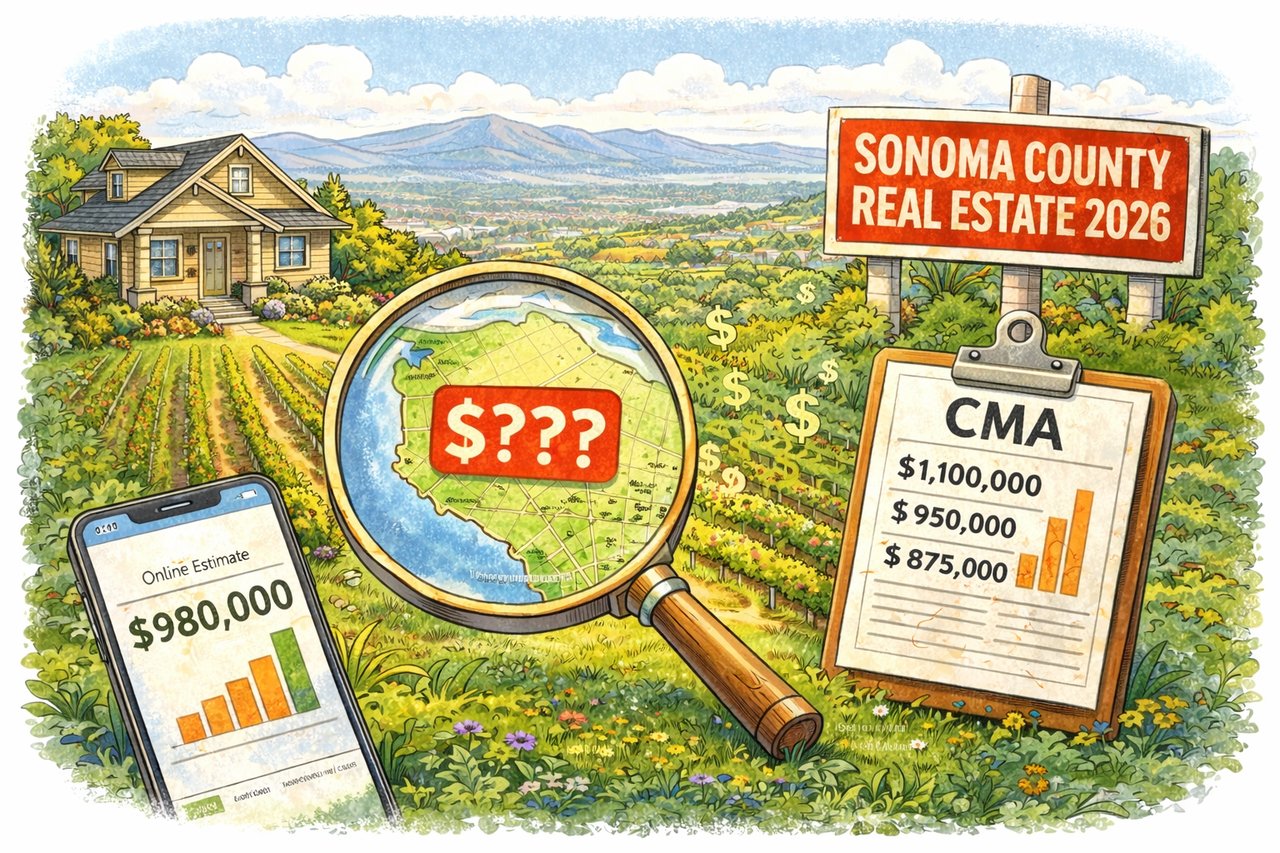
Sonoma County Home Values Explained (2026)
Nima April 7, 2026
Nima April 7, 2026
Sonoma County Home Values Explained (2026)
If you own a home anywhere in Sonoma County, you’ve probably noticed something over the last few years: home prices can move fast—and not always in the same direction as your expectations. One neighborhood feels “hot,” while another seems to slow down, even though both are under the same county name.
So when people ask me, “What’s my Sonoma County home worth in 2026?” the honest answer is: it depends—on where you are, what you have, and what kind of buyer you’re competing for.
This guide breaks down how home values actually work in 2026, what drives pricing differences between places like Santa Rosa, Windsor, and Petaluma, and how you can get a clearer, more actionable number than an online estimate.
WHAT ‘HOME VALUE’ REALLY IS (AND WHAT IT ISN’T) A lot of homeowners treat “home value” like a single number, but it’s more realistic to think about value as a range.
In 2026 Sonoma County, your home typically sits in a lane:
This matters because many sellers aim straight for stretch pricing without understanding what it takes to justify it. A stretch number can work, but it usually requires a standout condition, great presentation, and a strategy that creates urgency.
SONOMA COUNTY IS NOT ONE MARKET You cannot take a median “Sonoma County” price and apply it to your home like a formula. There are micro-markets everywhere:
When values vary this much, a “one number fits all” valuation becomes more fiction than reality.
THE BIGGEST DRIVERS OF VALUE IN 2026 Several factors are shaping home values this year across Sonoma County:
HOME VALUE METHODS: FROM ‘ESTIMATE’ TO ‘REALITY’ Here are the most common ways homeowners evaluate their value—along with the strengths and weaknesses of each.
Online valuation tools Pros: Quick, easy, good for curiosity. Cons: Often inaccurate because they can’t “see” upgrades, design, lot usability, street positioning, or nuanced local demand.
Price-per-square-foot comparisons Pros: Helpful as a rough tool. Cons: Misleading on homes with unique features, small homes, large custom homes, unusual lots, or major condition differences.
Appraisal Pros: Helpful for lending and a certain definition of value. Cons: Not always the same as “market value,” because “market value” includes buyer emotion and competitive behavior.
CMA (Comparative Market Analysis) Pros: Designed for real-world selling and buying decisions; incorporates current comparable sales, pending sales, and active competition. Cons: The accuracy depends on who prepares it and whether they truly understand your micro-market.
WHY YOUR HOME VALUE CAN CHANGE FAST In 2026, Sonoma County values can move because of:
That’s why “last month’s Zestimate” isn’t necessarily helpful today.
HOW TO READ A CMA LIKE A PRO When I prepare a CMA, I focus on:
If a CMA doesn’t incorporate active and pending listings, it can miss the target by a wide margin.
WHAT YOU CAN CONTROL (AND WHAT YOU CAN’T) You can’t control interest rates or the economy, but you can control:
YOUR NEXT STEP: GET A 2026-READY VALUE If you want a real Sonoma County home valuation—not a generic internet number—get a CMA built for your specific neighborhood, condition, upgrades, and competition.
If you’d like me to prepare a personalized value range for your home, send me:
From there, I’ll give you a realistic range and a clear strategy for how to maximize your net proceeds in 2026.
Bottom line: Sonoma County home values in 2026 aren’t confusing once you translate the market. With the right information, you can make smarter decisions—and capture more of what your home is worth.

real estate
A practical guide to comparing local agents, evaluating their advice, and choosing the right representation for your next move.

From the double-digit rates of the 1980s to today’s mortgage lock-in effect, discover why higher borrowing costs haven’t made Sonoma County homes substantially cheaper.
Compare Magnolia Park’s established neighborhood with University District, including homes, parks, daily routines, and the details that can change your buying decision.

A practical guide to down payments, closing costs, mortgage payments, and assistance options for Santa Rosa and Sonoma County homebuyers.

From M Section to University District, compare taxes, HOA fees, insurance and repairs before choosing your next home.

An October–December 2026 forecast for all nine cities, how local home values compare with California counties, and why Sonoma County remains a compelling place to live.

Before you remodel, learn which updates may not pay off, what buyers notice, and which repairs deserve attention before listing.

How assumable mortgages work, what they could save, and the upfront cash requirement that can change the entire deal.

The national 30-year average reached 7.03% on September 24. Here is what that changes for payments, pricing, negotiations, and home sales in Santa Rosa and across Sono… Read more
Whether you're buying, selling, or exploring options, Nima is dedicated to making the process smooth, informed, and rewarding. Reach out today for a personalized consultation and let’s make your real estate goals a reality!