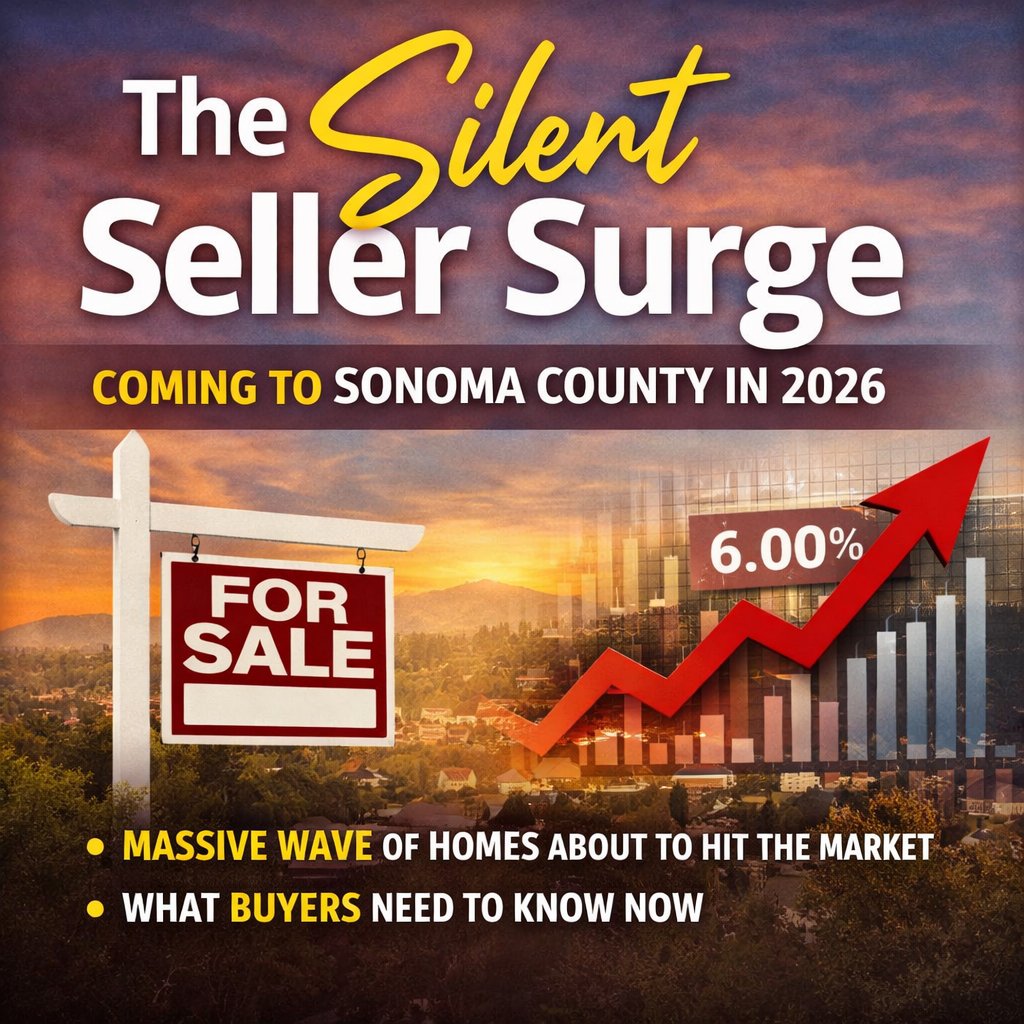
The “seller’s market” is shifting—quietly, at first
If you’ve been watching Sonoma County real estate, you’ve probably felt the tension: buyers are trying to time the market, sellers are waiting for the “perfect moment,” and yet homes still move when they’re priced right and prepared well.
But the biggest shift coming in 2026 isn’t loud.
It’s a silent seller surge: the moment when lots of homeowners, after sitting on high equity for years, decide the math finally pencils out to move—and they do it almost all at once.
This post breaks down the data that hints at a surge, the psychology behind it, and the practical steps you can take to capitalize on it—whether you’re buying or selling.
1) Mortgage rate movement is the first domino
One of the biggest triggers for a seller surge is mortgage rate stability.
The 30-year fixed mortgage rate averaged 6.00% as of March 5, 2026 according to Freddie Mac (and the Federal Reserve’s FRED data shows the same 6.00% reading for the week ending March 5, 2026).
That matters more than you think—not because 6% is “cheap,” but because stability reduces fear.
When rates stop rocketing from week to week, homeowners stop thinking, “I’ll wait for things to calm down,” and start thinking, “This is probably the new normal—maybe I should move.”
The psychological line: 5.99% feels different than 6.00%
Several finance-focused analysts and commentators point out that when rates dip just below certain thresholds (like 6%), demand can increase simply because consumers react to “a 5 in front” differently. Whether you think that’s silly or not, it’s real.
And in real estate, perception becomes behavior.
2) Sonoma County values have created “locked-in equity” sellers
Sonoma County home values are high enough that many owners are sitting on significant equity, even if price growth has been uneven.
Zillow’s Sonoma County housing market snapshot shows an average home value of $770,224 (updated January 31, 2026), noting prices down 2.7% year over year, with homes going to pending in around 46 days.
That combination is important:
-
Prices still high relative to long-term history → owners have equity
-
Days on market moderate → buyers are active enough to absorb inventory
-
Some softness year over year → sellers sense they can’t wait forever
When you put those together, you get the “maybe we should sell while the equity is still near peak” mindset.
And that mindset doesn’t lead to one listing— it can lead to hundreds.
3) Inventory signals: low right now, poised to jump quickly
Sellers don’t announce a surge. It shows up in metrics.
A localized Sonoma County market snapshot in early February 2026 reported:
-
Active Listings: 536
-
Months of Inventory: 1.94
-
Median Days on Market: 71
-
Median Sold Price: $800,000
Translation: the county is sitting at very low supply, which means any meaningful increase in new listings would show up fast—because the baseline is so low.
And if those listings are better-prepared than typical (fresh paint, staged, priced strategically), they may still move quickly—only now the market feels different:
More choice. More urgency. More competition.
This is exactly what pushes buyers to act.
4) State and national data support a “release valve” narrative
This isn’t just a Sonoma County phenomenon.
The California Association of REALTORS® reported that California home sales fell to a low in January 2026, down from December and January 2025. When home sales dip broadly, pent-up demand builds on both sides:
When conditions stabilize, you get release.
At the national level, Reuters reported a 1.7% increase in existing home sales in February 2026, with rising supply but still below pre-pandemic levels, and the share of first-time buyers hitting a five-year high. That’s a big signal: affordability improving just enough can unlock long-sitting sellers and long-waiting buyers simultaneously.
5) Why 2026 is a seller surge year—not a seller surge week
If you’re looking for the exact moment the floodgates open, that’s not how this works.
A silent seller surge is more like:
-
Spring 2026: inventory starts to climb
-
Summer 2026: the narrative shifts—“There are more options now”
-
Late 2026: pricing becomes more nuanced; winners are those who adapt
Sellers who list in the early part of a surge often do better than sellers who list after buyers feel overwhelmed by options.
6) The “silent surge” sellers: who they are, really
From repeat buyers to downsizers to relocation sellers, there’s a common thread: life events.
NAR’s ongoing research and reporting consistently emphasizes that limited inventory has shaped behavior heavily in recent years—but when housing conditions improve even slightly, it can free people to make the moves they’ve been delaying.
Add in equity, stability, and confidence, and you get the real surge:
-
Downsizers who don’t want to maintain a large property anymore
-
Move-up buyers who can transfer equity into a larger home
-
Relocation sellers who are finally ready to commit
This surge isn’t “extraordinary demand.” It’s catch-up demand.
7) If you’re a buyer: your advantage is readiness
In a seller surge, buyers finally get options—but they also lose excuses.
Here’s what readiness looks like in 2026:
-
Underwrite, don’t just pre-qualify. You want strength documented early.
-
Decide your non-negotiables now (schools, commute, acreage, condition).
-
Define your walkaway price before the offer deadline.
-
Use a 24-hour decision framework: see it → run numbers → decide.
Because if inventory rises, you don’t win by waiting. You win by executing.
8) If you’re a seller: your advantage is timing plus preparation
The best time to sell isn’t a date on a calendar.
It’s the moment where your neighborhood has:
-
low competing inventory, and
-
strong buyer urgency, and
-
market stability that reduces uncertainty
That’s why the “silent seller surge” matters so much: it changes those conditions quickly.
The seller playbook for 2026
-
Get a pre-listing inspection to avoid deal-killing surprises
-
Invest in first impression updates: paint, landscaping, lighting
-
Stage for photos (because clicks determine showings)
-
Price to trigger activity—not to “win an argument”
-
Launch strategically: maximize the first 72 hours online
These aren’t clichés. They are the tactics that take advantage of a surge instead of being swept away by it.
Key takeaway (best pulled for “featured snippet”)
Sonoma County’s housing market is primed for a silent seller surge in 2026 because mortgage rates are stabilizing near 6%, equity-rich owners are ready to move, and inventory is so low that even a moderate listing increase will change buyer behavior quickly.
Quick FAQ (Google/AI search intent)
Is Sonoma County expected to see more listings in 2026?
Yes—many indicators suggest more homeowners will list as rates stabilize around 6% and pent-up life-event demand is released.
Are home prices crashing in Sonoma County?
Most signals point to stability with modest gains possible in high-demand areas; broad declines typically require major economic shocks.
What should buyers do differently in 2026?
Get fully underwritten, define your non-negotiables now, and be ready to make fast decisions as inventory rises.
What should sellers do differently in 2026?
Prep aggressively, price strategically, and list earlier rather than waiting for the surge to become crowded.
Where can I find data sources you referenced?
Freddie Mac weekly rates, FRED mortgage-rate series, and Zillow market snapshots are great starting points.
Want a quiet advantage in a quiet surge?
If you’re thinking about buying or selling in Sonoma County, I’ll help you build a data-driven plan based on what’s happening right now—not last year’s assumptions.
(And if you tell me your city and price range, I can tailor this strategy in under two minutes.)