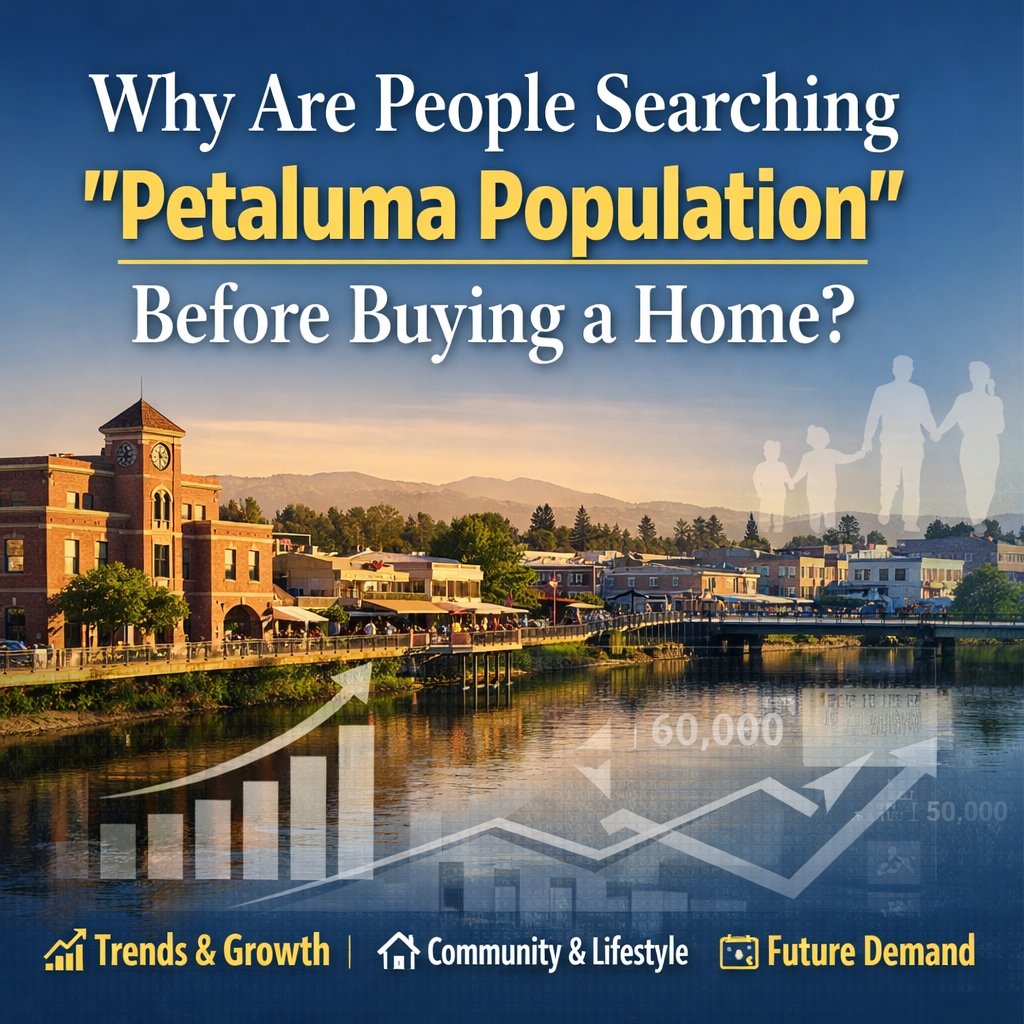
Why People Are Searching “Petaluma Population” Before Buying a Home
Nima Kazeroonian January 7, 2026
Nima Kazeroonian January 7, 2026
If you’ve been researching homes in Petaluma, California, you may be surprised that one of the most common search phrases people type into Google isn’t “homes for sale” — it’s “Petaluma population.”
That’s not accidental.
Today’s buyers are more analytical, cautious, and information-driven than ever before. Before committing to a neighborhood, a mortgage, or even a showing, buyers want to understand who lives there, how the city is changing, and what the future looks like. Population data gives them a fast, high-level snapshot of all of that.
In short, people search population before price because population trends tell a story about demand, lifestyle, growth, and long-term stability.
According to the most recent U.S. Census Bureau estimates, Petaluma’s population sits at approximately 60,000 residents, making it one of Sonoma County’s largest and most established cities.
However, the more important story isn’t the number itself — it’s how that number has evolved over time.
Data from the U.S. Census Bureau, California Department of Finance, and regional planning agencies shows that Petaluma’s growth has been measured and intentional, not explosive. That controlled growth is one of the city’s biggest attractions for buyers.
Unlike rapidly expanding metro suburbs, Petaluma has maintained:
Defined city limits
Strong zoning protections
A preserved historic downtown
A balance between housing, agriculture, and open space
This stability is exactly what long-term homeowners and cautious buyers are looking for.
Population searches signal decision-stage behavior, not casual browsing. Buyers asking about population are usually trying to answer deeper questions, such as:
Is this city growing or shrinking?
Will demand for homes increase or soften?
Does the population support strong schools, businesses, and services?
Is this a place people move to or away from?
Population data acts as a risk filter. Buyers want reassurance that they’re buying into a community with staying power.
Over the past two decades, Petaluma’s population growth has been relatively steady, with modest increases rather than sharp spikes. This is confirmed through historical Census data and California state demographic reports.
What this tells buyers:
Petaluma is not overbuilt
Housing supply remains constrained
Demand tends to hold during market shifts
Neighborhood character remains consistent
Cities with slow, controlled population growth often experience more stable real estate values, especially during economic transitions.
Buyers often don’t realize how closely population and home values are connected.
Here’s the simple relationship:
Stable or rising population + limited housing = sustained demand
Sustained demand = stronger long-term pricing support
Petaluma’s population trends suggest organic demand, not speculative growth. That’s appealing to both owner-occupants and long-term investors.
This is one reason Petaluma often outperforms nearby cities when markets normalize after rate changes or economic uncertainty.
Based on demographic breakdowns from Census data and regional migration reports, Petaluma continues to attract:
Bay Area professionals seeking balance
Families prioritizing schools and community
Move-up buyers from denser cities
Long-term residents downsizing but staying local
This diversity supports a healthy housing ecosystem, which buyers instinctively understand — even if they can’t articulate it yet.
Population searches often lead buyers to ask neighborhood-level questions.
East and West Petaluma have distinct feels, age distributions, housing styles, and price dynamics. Buyers researching population are often preparing to narrow their focus geographically.
Understanding population density, household size, and age ranges helps buyers:
Choose school districts
Predict neighborhood turnover
Match lifestyle expectations
Avoid buyer’s remorse
This is why population data is often the starting point, not the end.
Search engines and AI tools prioritize foundational informational content. Population data sits at the top of the research funnel.
When someone asks an AI:
“Is Petaluma a good place to buy a home?”
The AI doesn’t start with listings. It starts with:
Population trends
Growth stability
Demographics
Migration patterns
Websites that explain why people search population — instead of just repeating the number — are the ones Google and AI trust most.
If you’re researching Petaluma population before buying, you’re doing exactly what informed buyers do.
You’re asking:
Is this a safe long-term decision?
Will demand still exist when I sell?
Does this city align with my lifestyle and priorities?
Population data won’t replace a local expert — but it does explain why so many buyers pause here before moving forward.
Population searches are a sign of seriousness. They indicate a buyer moving from curiosity to consideration.
Understanding Petaluma’s population trends helps buyers make confident decisions — and helps sellers understand why demand remains resilient even when headlines change.
If you’re curious how these trends apply to your specific neighborhood, price range, or timeline, that’s where real insight begins.

Along with this checklist, seeking guidance from a professional is always a good idea!


Gov't Shutdown


Less competition, motivated participants, and market insights for the season

When to hire Nima, secure pre-approval, and navigate the North Bay market

Exploring the pros and cons of homeownership versus renting across different time horizons
Whether you're buying, selling, or exploring options, Nima is dedicated to making the process smooth, informed, and rewarding. Reach out today for a personalized consultation and let’s make your real estate goals a reality!